
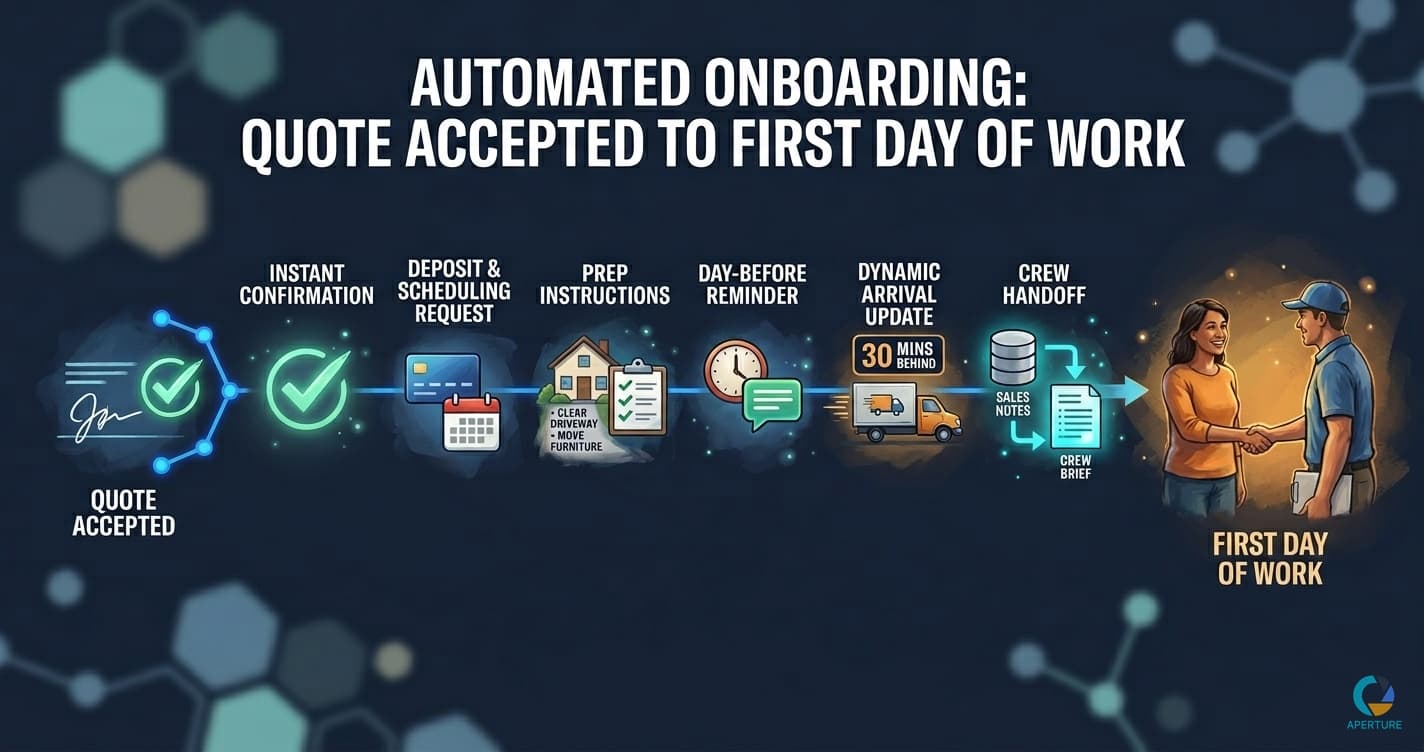
Customer onboarding automation for service businesses is the set of triggered workflows that handle every step between the moment a quote is accepted and the first day of work: confirmations, reminders, prep instructions, crew assignments, and the small communications that decide whether the job starts clean or on fire. For an HVAC shop, a plumber, a landscaper, or a roofer, this is the window where trust is either earned or lost. Most owners never see it as a system because it does not have a name. It just happens, in pieces, across text messages and phone calls and sticky notes, at a different quality level every time. This post walks through what customer onboarding looks like for a service business, what to automate, and why it is one of the highest-leverage changes a service owner can make.
What Is Customer Onboarding Automation for a Service Business?
Customer onboarding automation for a service business is the use of triggered workflows and messaging tools to handle every repeatable step of getting a new job from signed quote to first day on site, without requiring the owner or a dispatcher to manually run each step. It covers the appointment confirmation, the pre-visit prep instructions, the "who is coming and when," the change-of-plan notifications, the reminders, and the handoff to the crew.
This is not the same as client onboarding for agencies and professional services, which covers long-cycle B2B relationships with kickoff calls, access provisioning, and account setup. Service business customer onboarding is short-cycle and physical. A homeowner signs a quote for a new furnace install, and five days later a truck shows up at their door. Everything that has to happen between those two moments is customer onboarding. And almost none of it is designed.
Why Does Customer Onboarding Matter for Service Businesses?
Because the quote-to-first-day window is where customer experience is made or broken, and the research is unambiguous about what customers expect. A 2025 Housecall Pro survey of 1,040 US homeowners found that 97% of homeowners say speed and transparent pricing impact their hiring choices, 80% factor online booking into their decision, and 59% expect text updates during active jobs. The same survey found that 35% of homeowners are frustrated by late arrivals and 58% are reassured by a technician photo and ID sent before a visit.
Put that together and the picture is obvious. Customers are making retention decisions before the first wrench turns. If the confirmation is vague, if the reminder never comes, if nobody texts them when the crew is running late, that is the experience that sticks. That is the review they leave. That is the referral they do not make.
Customer onboarding is also where owners lose the most time to process that was never designed. Every new job triggers the same basic sequence: confirm the appointment, send the deposit request, send the prep instructions, remind them the day before, reassign if the crew changes, update the customer if something slips. Most service businesses handle each of those steps with a text message typed from scratch or a call from the dispatcher. That is not a customer experience. That is a dispatcher working nights.
How I Learned That Onboarding Is Where Customers Are Won or Lost
After I sold my agency in 2021, I spent a few years doing fractional operations consulting for service businesses and agencies. Different industries, different team sizes, same pattern. Every single engagement that started with "we are losing customers and I do not know why" ended in the same place: the quote-to-first-day gap.
It was never the quality of the work. The work was fine. The technicians were good, the service was solid, the final product was what was promised. The customers were getting lost in the gap between "yes, book it" and "we are on our way." The deposit request was vague. The confirmation was a phone call the next day. The reminder never went out. The arrival update never happened. By the time the crew showed up, the customer had already decided they did not love this company, even though nothing had technically gone wrong yet.
I would walk into a business, ask the owner to describe their customer onboarding process, and they would describe the sales handoff and the first day of work and skip the entire window in between as if it was nothing. "And then the crew shows up." That is where all the trust was getting built or broken, and nobody had a process for it. The dispatcher was improvising. The salesperson thought it was dispatch's job. Dispatch thought it was sales'.
The fix was almost never a new tool. It was writing down what the sequence should be and putting it into the field service platform the business already owned. When we did this, review scores climbed within a month. Not because the work changed. Because the communication stopped being random.
What Steps Should Be Automated Between Quote Accepted and First Day of Work?
There are six. Every service business has a version of all six, whether they are named or not.
1. The Instant Confirmation
The second a customer says yes, they should get a confirmation. Name of the company, what was bought, what comes next, how long until the next contact, who to call if something changes. This is the moment of peak anxiety for the customer. They just spent money. They want to know the transaction is real.
Most service businesses handle this with a follow-up call the next day. By then, the customer has already looked at one competitor, forwarded the quote to their spouse, and started second-guessing. An instant confirmation, even just a templated text with the next steps, removes that gap.
2. The Deposit or Scheduling Request
If a deposit is required, or if the customer needs to book a time slot, that has to be the next automated step. The message can be a payment link, a calendar booking link, or both. What it cannot be is a phone call on Tuesday afternoon from the office manager. Friction at this step is where quotes die.
3. The Prep Instructions
Every service job has prep. Move the furniture away from the wall. Clear the driveway. Unlock the side gate. Turn off the water at the street. Make sure someone over 18 is home. These instructions are almost never sent in writing, which is why crews show up to customers who have not prepared.
Automated prep instructions pre-framed the day after booking solve a problem the owner probably does not know they have. Asana's Anatomy of Work Index, based on a survey of 9,615 global knowledge workers, found that 62% of the workday is lost to repetitive, mundane tasks. For a service business, "mundane" looks like a dispatcher texting ten people the same prep reminder. That is a workflow, not a judgment call.
4. The Day-Before Reminder
A day-before text is not optional. The Housecall Pro survey found that 59% of homeowners expect text updates during active jobs, and those expectations start before the job begins. A reminder confirming the appointment, the estimated arrival window, and the crew name reduces no-shows, reschedules, and "I forgot" moments. It is also where you catch problems early. If the customer has a conflict, you find out at 6pm the night before, not at 8am when the crew is already on the road.
5. The Dynamic Arrival Update
The crew leaves the previous job late. Traffic is bad. The previous install took longer than expected. Every one of those events triggers a text to the current customer: "We are running about 30 minutes behind, we will be there by 10:45." This is the single highest-leverage automation in customer onboarding because it prevents the phone call that costs dispatchers the most time and customers the most trust.
Automating this does not mean removing the human. It means one click from the dispatcher sends a pre-written message to the right customer at the right time. The work changes from "write a text from scratch" to "acknowledge a status change."
6. The Crew Handoff
The last step is inside the company, not with the customer. The crew that arrives needs the captured details from the sales conversation: what was quoted, what the customer asked about, what to watch out for, whether there is a dog, whether access is through the back. Most service businesses handle this in a huddle on the way out, which means details get lost.
A structured handoff, whether it is a PDF generated from the CRM or a brief in the dispatch app, is how the sales promise becomes the service reality. Without it, customers hear "we told the sales guy we needed the crew to be quiet because my husband works nights" and the crew, not knowing, runs the saw at 7am. That is an avoidable review.
How Does This Actually Save Money?
Customer onboarding automation moves two numbers: no-show rate and review score. Both compound.
Consider what the Slack survey of 2,000 US small business owners found in August 2024: owners lose 96 minutes per day to wasted time, about three weeks a year, with 29% repeating messages across platforms and 30% searching for information in the wrong places. For a service business owner, a lot of that "wasted time" is the unscripted communication work of running a job: the "where are we at" text to the crew, the "running late" text to the customer, the "did the deposit come through" check. Each one takes a minute. Each one is an automation candidate.
Then consider the compounding side. Customer onboarding automation raises on-time arrival, closes the communication gaps, and nudges customers toward higher review scores. Reviews drive referrals. Referrals drive new jobs. The math on customer lifetime value only works if the customer comes back or tells someone. Both depend on the first experience, and the first experience is decided almost entirely during onboarding.
According to a 2022 Gartner survey of 699 executives, 80% believe automation can be applied to any business decision. The question for service business owners is not whether to automate onboarding. It is which of the six steps above gets automated first. My answer: the day-before reminder and the dynamic arrival update. Together they eliminate 80% of the "where are they?" calls that eat a dispatcher's day.
What Tools Actually Work for Customer Onboarding Automation?
Most service businesses do not need new software. They need to use the tools they already have correctly. Housecall Pro, Jobber, ServiceTitan, FieldEdge, and similar field service platforms all have workflow automation built in. The question is whether anyone has configured them, and whether the workflows match the actual process the business runs.
This is where the work starts to look like process capture and process mapping rather than tool evaluation. If the business has never documented the sequence from quote to first day, nobody can build the automation, because nobody has the spec. I have seen owners spend thousands on a new field service platform and never configure the automated reminders because they never sat down and mapped what the reminders should say or when they should fire. The software was not the problem. The missing specification was.
Why Does Customer Onboarding Break at the Handoff From Sales to Service?
Because sales knows things the crew needs to know, and nobody has built a structured way to pass those things along. The customer told the sales rep "we have a baby who naps at 1pm, can the crew work around that." The sales rep wrote it on a sticky note that never made it into the CRM. The crew shows up at 12:45 and starts a drilling job. The review drops a star.
Handoff breakdowns are almost always a data problem. The salesperson captures context verbally that never gets structured. A fix does not require new software. It requires a short form the salesperson completes before the deal is marked closed-won, which then auto-populates a brief the crew sees on their dispatch screen. That is a 10-minute automation with a large return.
This is also where service businesses start to feel the value of real AI-driven automation rather than the rule-based kind. A simple workflow tool can send a text at a fixed time. An AI system can read the sales notes, identify the "babies nap at 1pm" constraint, and add it to the crew brief automatically. The rules-based automation handles the predictable parts. The AI handles the unpredictable parts that used to require a human in the loop.
Where Do You Start if You Have Never Automated Customer Onboarding?
Start with the day-before reminder. It is the easiest automation to set up, it has the highest immediate impact, and it creates the fastest proof that customers notice the change. From there, add the instant confirmation after the quote is accepted. Then add the dynamic arrival update. Those three automations alone cover most of the no-show, miscommunication, and trust erosion that happens between quote and first day.
The rest can be layered in over a quarter. The goal is not to automate everything at once. The goal is to pick the one step that is costing you the most right now and build the automation for that step first. Then the next. Then the next. The flywheel builds itself once the first automation is running.
Ready to figure out which step is costing you the most? Start a conversation with Steve at Aperture OS →
Evan Van Dyke is the founder of Aperture OS. He spent seven years running a marketing agency, scaling 100+ businesses, eventually systemizing it to three hours a week, and sold it in 2021. He now builds AI automation systems for business owners. About Evan →
Frequently Asked Questions
Q: What is the difference between customer onboarding and client onboarding for a service business? Customer onboarding refers to the homeowner or end-user experience from the moment a quote is accepted through the first day of work: confirmations, reminders, prep instructions, and crew handoffs. Client onboarding is typically a B2B term used by agencies and professional services for the longer-cycle process of kicking off a new client engagement. Service businesses run customer onboarding most of the time.
Q: What should I automate first in the customer onboarding process? Start with the day-before appointment reminder. It has the highest immediate impact, the lowest technical complexity, and it directly reduces no-shows and same-day cancellations. From there, add the instant confirmation after the quote is accepted, then the dynamic arrival update when the crew is running late. Those three cover most of the customer experience failures between quote and first day.
Q: Do I need to buy new software to automate customer onboarding? Probably not. Most service businesses already own a field service management platform like Housecall Pro, Jobber, or ServiceTitan that has workflow automation built in. The real gap is usually that the workflows have never been configured. Map the process first, write the messages that should fire at each step, then load them into the tool you already have.
Q: How does automated customer onboarding affect no-show rates? Directly. A structured day-before reminder plus a dynamic arrival update on the day of the job reduces no-shows, same-day cancellations, and dispatcher phone calls. The Housecall Pro 2025 survey of 1,040 homeowners found that 59% of customers expect text updates during active jobs and 35% are frustrated by late arrivals. Both of those expectations are met or broken during the onboarding window.
Q: What is the biggest mistake service businesses make with customer onboarding? Treating it as a dispatcher problem rather than a designed process. Most service businesses handle confirmations, reminders, and arrival updates as ad-hoc messages typed from scratch by whoever is at the desk that day. That produces inconsistent quality, wastes dispatcher time, and leaves customers without the updates they expect. The fix is to capture the onboarding sequence once and automate the repeatable parts. See how Aperture OS runs the capture →