
Most businesses trying to implement AI automation are solving two different problems at once: eliminate repetitive rule-based work, and handle situations that require judgment. These are different problems with different solutions. Treating them as one thing is why most automation projects fail.
Traditional automation and AI automation are complementary tools. They work best together, in sequence, applied to different parts of the same workflow.
What Is Traditional Automation?
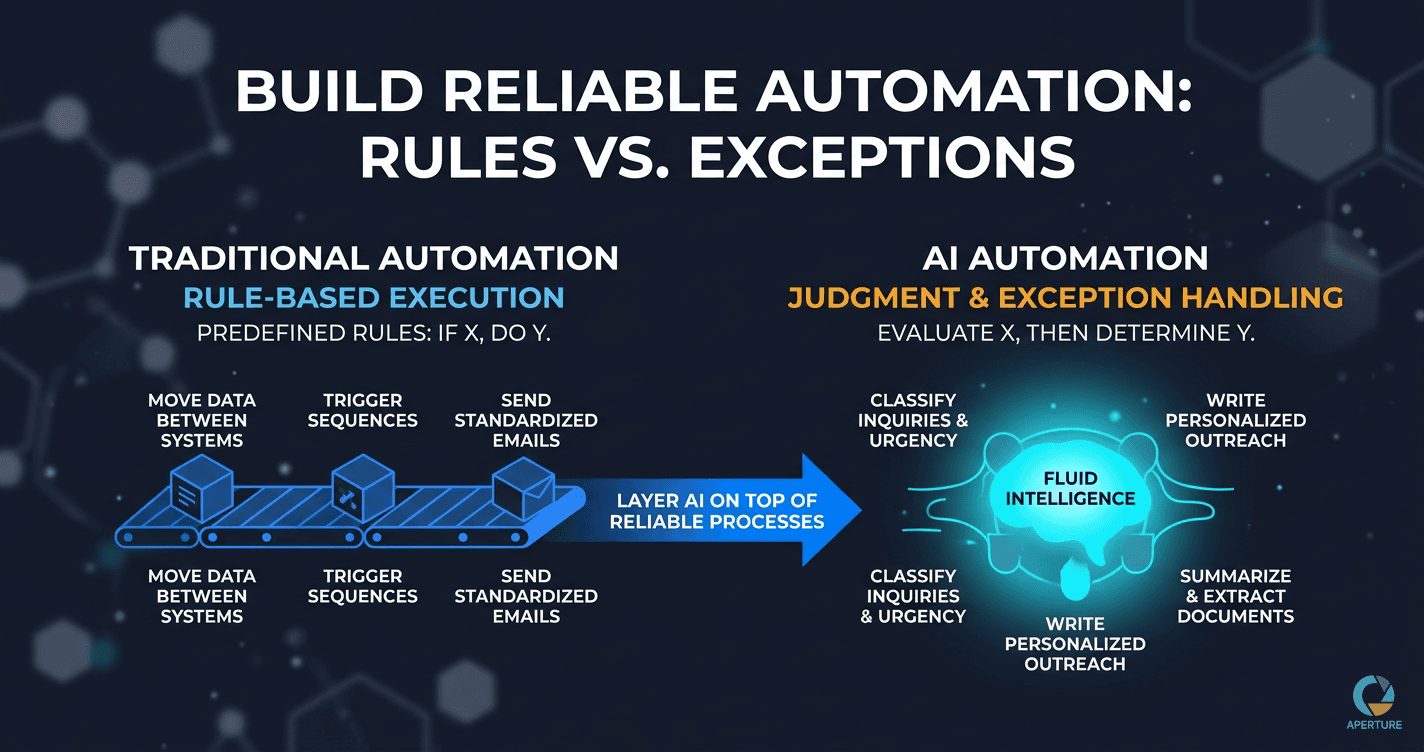
Traditional automation executes predefined rules. When X happens, do Y. If a form is submitted, create a CRM record. If a contract is signed, send the intake form. If an invoice is received, log it in the accounting system and notify the approver.
Tools in this category include Zapier, Make, n8n, and custom code. They connect systems, trigger actions, move data, and execute steps without human intervention. They are fast, reliable, and completely predictable.
The limitation is the word "predefined." Traditional automation does exactly what you told it to do. If a situation falls outside the rules you defined, it fails, routes to a default, or produces the wrong output. It has no ability to interpret context or exercise judgment.
What Is AI Automation?
AI automation adds a layer of judgment. It can read and interpret input, handle situations that don't fit a single rule, produce outputs that vary based on context, and make in-bounds decisions.
Instead of "if X, do Y," AI automation handles "evaluate X, then determine the appropriate Y." Classify this support ticket as urgent or standard. Write a personalized follow-up email for this specific lead based on their intake form. Summarize this document and flag the two points that need human review. Triage these requests by estimated business impact.
AI is probabilistic, not deterministic. It does not guarantee the same output every time for the same input. It produces the most likely correct output given the available context. That's a strength for tasks requiring interpretation. It's a liability for tasks requiring consistency.
Where Does Each Type Work Best?
| Task Type | Best Fit |
|---|---|
| Moving data between systems | Traditional |
| Triggering sequences from events | Traditional |
| Sending standardized emails | Traditional |
| Creating project records | Traditional |
| Routing standard requests | Traditional |
| Classifying inquiries by type or urgency | AI |
| Writing personalized outreach | AI |
| Summarizing and extracting from documents | AI |
| Handling exception cases | AI |
| Making in-bounds decisions | AI |
The dividing line: if the task produces exactly the same output every time given the same input, traditional automation handles it better. If the task requires reading context and producing variable output, AI is stronger.
Why Most Businesses Get the Sequence Wrong
The mistake is trying to use AI to replace process clarity instead of to amplify a process that already works.
A business with a poorly documented, inconsistently executed onboarding process doesn't fix it by layering AI on top. The AI inherits all of the existing problems and adds new ones. The output is unpredictable because the underlying process is unpredictable.
Traditional automation has the same failure mode, but it's faster to diagnose: when traditional automation breaks, you know exactly where it broke because the rules are explicit. When AI breaks on a bad process, the failure is harder to locate because the AI was making judgment calls throughout.
The right sequence starts with documenting the process. Why process mapping comes before automation is the topic most automation guides skip, and skipping it is the reason most automation projects fail. Automate the rule-based steps with traditional tools only after the map exists, then layer AI on top once the underlying process is reliable. This is the three-phase approach that separates successful automation from expensive experiments.
What I Learned Building Aperture OS
After selling my agency, I spent three years doing operations consulting manually. Every engagement started the same way: two to three weeks of diagnostic work, mapping processes, identifying automation opportunities, handing over a roadmap.
I was asking the same categories of questions every time. Looking for the same patterns. Most of that initial work was executing a process, not exercising judgment. The judgment came later, when I was analyzing what I found.
When I started building Aperture OS, I realized the first 80% of every engagement could be done by AI. Not the strategic judgment, not the prioritization, not the "here's what I'd do and why" part. The discovery work. The question-asking. The pattern recognition in what a business described about itself.
AI could handle the diagnostic. I could handle the insight. That division of labor is the same one that applies to any business process: let automation handle what follows rules, keep humans in the loop for what requires judgment. Building Aperture OS was the direct application of that lesson from seven years of doing it manually.
How the Two Work Together in Practice
A client services business handling inbound leads is a good example, and client onboarding automation is where both types work most visibly in sequence. The full workflow uses traditional automation for predictable steps and AI for the parts requiring interpretation.
Traditional automation handles:
- Lead form submitted, CRM record created automatically
- Zapier triggers qualification email sequence
- Calendar confirmation sent when call is booked
- Project creation triggered in Monday after the call
- Contract sent through PandaDoc, intake form triggered on signature
AI handles:
- Classifying the lead inquiry by service type and urgency before routing
- Drafting a personalized first-touch email based on the specific form content
- Summarizing call notes and extracting the three key client needs
- Flagging follow-up tasks that require human attention
Neither layer does the other's job well. Traditional automation writing a "personalized" email sends the same email to everyone. AI creating a CRM record from a form is using a power drill to turn a screw.
The combined system is more capable than either alone because each is doing what it's actually built for.
How Do You Know Which Type You Need?
The fastest diagnostic: describe the task in one sentence, then ask whether someone unfamiliar with your business could follow rules to produce the correct output every time.
"When a form is submitted, create a CRM record with these fields" — yes. Traditional automation.
"When a lead submits a form, write a follow-up email that references their specific problem and suggests the most relevant service" — no. AI.
If the answer is somewhere in the middle, you likely need traditional automation for the routing and AI for the variable output. Most real workflows are in the middle.
The key is not choosing between them. It's using the right tool for the right step, with a documented process underneath both. Start by finding what to automate, build the traditional automation layer first, and layer AI on top once the process is stable.
Start a conversation with Steve at Aperture OS →
Evan Van Dyke is the founder of Aperture OS. He spent seven years running a marketing agency, scaling 100+ businesses, eventually systemizing it to three hours a week, and sold it in 2021. He now builds AI automation systems for business owners. About Evan →
Frequently Asked Questions
Q: What is the difference between AI automation and traditional automation? Traditional automation follows predefined rules: when X happens, do Y. It is fast, reliable, and predictable but breaks outside its rules. AI automation adds judgment: it interprets context, handles exceptions, and produces variable outputs based on input. Traditional automation is deterministic. AI automation is probabilistic. Both belong in a complete operations stack.
Q: Do I need traditional automation before I can use AI automation? For most processes, yes. Traditional automation creates a reliable baseline that AI can then augment. Layering AI onto an undocumented or unreliable process means the AI inherits all of the existing problems and adds new ones. Build the reliable process first.
Q: What tasks are best suited for traditional automation? Tasks that produce the same output every time given the same input: moving data between systems, triggering sequences from events, sending standardized communications, creating records, and routing standard requests. If the logic is deterministic, traditional automation handles it better and more reliably than AI.
Q: What tasks are best suited for AI automation? Tasks requiring interpretation, judgment, or variable output: classifying inquiries, writing personalized communications, summarizing documents, triaging requests by urgency, and handling exception cases. AI does not replace the underlying process. It handles the parts the process cannot deterministically resolve.
Q: What is the right sequence for implementing both? Map the process. Automate rule-based steps with traditional tools. Once automation is running reliably, layer AI on top for exceptions, personalization, and in-bounds decisions. This is the three-phase sequence. Skipping to AI before completing the first two phases is the most common reason automation projects fail. See how Aperture OS guides this →