
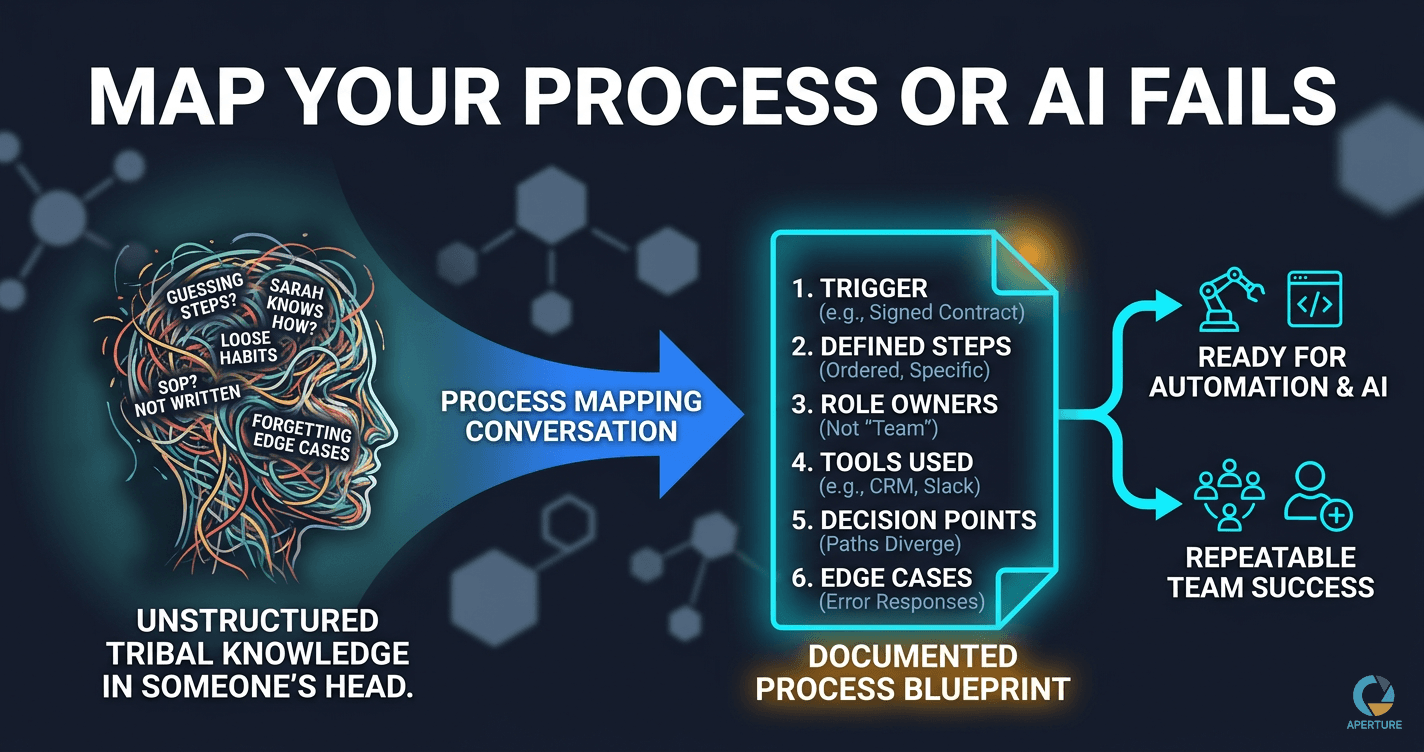
Business process mapping has to come before automation because every automation tool needs a specification. It needs to know what triggers the workflow, what happens in sequence, what conditions branch the logic, and what to do when something breaks. Without a mapped process, you are automating a guess: the workflow runs for the normal case and fails on the first edge case nobody documented. Map first, then automate. That sequence is not optional.
Business process mapping is how you get a process out of someone's head and into a document that can be followed, improved, and eventually automated. If a process only lives inside a person, no tool, AI or otherwise, can help you run it without that person.
What Is Business Process Mapping?
A business process map is a complete document capturing every step of a workflow: the trigger that starts it, each step in sequence, who owns each step, what tools are used, where decisions diverge, and what happens in edge cases.
This is not a new concept. Large organizations have been documenting processes for decades. The difference for small businesses is that most processes have never been written down. They exist as tribal knowledge, transmitted through demonstration and habit, maintained by whoever has done them the longest. "How do we handle a new client?" The answer is in Sarah's head, and Sarah has worked here for five years.
Business process mapping extracts that knowledge and makes it structural. Once a process is mapped, it belongs to the business, not an individual. It can be handed to a new hire, handed to a tool, or handed to an AI system that needs a specification to work from.
Why Do Business Processes End Up in People's Heads?
Because there was never time to write them down, and because when you're operating at speed, undocumented processes feel fine. The output appears. Clients don't complain. The work gets done. Nobody flags it as a problem until someone leaves, or you try to scale, or you want to automate something and realize the logic has never been captured anywhere outside a person's memory.
There's also a subtler dynamic: the people who would need to document these processes are the same people who execute them. The account manager running fifteen client relationships has no incentive to spend a Friday afternoon documenting her onboarding process. She already knows it. The documentation doesn't help her. It helps the business, the person who replaces her, and the tool that might eventually do part of her job.
So it stays in her head. The business becomes dependent on her availability. And when change is needed, the map doesn't exist.
What Does a Good Process Map Actually Include?
It doesn't need to be a flowchart, though flowcharts work well for processes with complex branching logic. A good process map is complete. It answers these questions:
Trigger: What event starts this process? A signed contract, a form submission, a specific calendar date, an invoice received?
Steps: What happens, specifically, in order? "Send welcome email using the template in Google Drive, folder Client Onboarding" is a step. "Do the welcome stuff" is not.
Owners: Who does each step? Not "the team." A role, a name, a defined position.
Tools: What system handles each step? CRM, Zapier, a spreadsheet, Slack, a shared Google Doc?
Decisions: Where do paths diverge? If a client hasn't responded in 48 hours, what happens? If the project scope changes after kickoff, who owns that conversation?
Edge cases: What can go wrong, and what is the documented response?
A map with all of this is complete. A list of rough steps is a first draft.
How Do You Extract a Process That Has Never Been Written Down?
Conversation is the most effective method. Ask the person who executes the process to walk you through it start to finish, then ask follow-up questions until there are no gaps.
The questions that surface the most detail:
- What causes this process to start?
- What is the first thing you actually do?
- What do you need before you can do that?
- What tool do you use for that step?
- How long does that step take?
- What happens next?
- What do you do when [the most common thing that goes wrong] happens?
- How do you know the process is complete?
Write everything down. Don't filter for what seems important. The goal of the first pass is to get everything out of the person's head, not to produce a polished document.
Then test it. Hand the map to someone who has never done this process and ask them to follow it. Every question they ask is a gap. Every place they get stuck is a missing step. Fill those gaps before calling it done.
What Happens When Teams Work Without Documented Processes?
When I worked with a production company as a fractional ops consultant, their marketing, PR, and sales teams had been working side by side for years. Each team had talented people. Each team had their own tools, their own rhythms, their own way of handling handoffs. Projects that required all three teams moved slowly, got stuck, and sometimes got dropped entirely.
The problem was not the people. It was that the three teams had never been asked to write down how they handed work to each other. There was no documented handoff protocol. There was no defined point at which one team's responsibility ended and another's began. Every transition happened through informal communication, and informal communication at scale is expensive.
I built sprint processes and cross-team SOPs. The quality of the work did not change. What changed was that the work had a visible structure for the first time. Handoffs happened at defined checkpoints. Responsibilities were written down. The same coordination conversations stopped happening in three separate meetings.
That is what process mapping does. It does not teach talented people their jobs. It gives their collaboration a structure it never had.
Why Does Process Mapping Have to Come Before Automation?
Process mapping has to come before automation because every automation tool needs a specification. It needs to know what triggers the workflow, what happens in sequence, what conditions branch the logic, and what to do when something breaks. Without a mapped process, you're automating a guess. The automation works for the normal case and fails on the first edge case, because nobody documented what should happen when conditions change.
When I was running the agency, the quoting process alone consumed 12 hours a week. We couldn't automate it until we'd documented the decision logic that lived entirely in one person's head. That business process capture took 45 minutes of structured conversation. The automation that followed ran for years.
This applies to every tool in the category. Zapier, Make, n8n, and custom-coded workflows all require you to know exactly what should happen, in what sequence, under what conditions. They connect systems, trigger actions, route data, and eliminate manual steps. But none of them can define the process for you.
The same principle applies to AI. Generic inputs produce generic outputs. A complete process map is a specific input. When you provide an AI tool with a fully documented process, the output changes. The AI is working from a specification, not guessing at what your business needs.
This is why every automation project starts with process discovery, and why AI automation fails when businesses skip straight to building.
How Long Does It Take to Map a Business Process?
For most processes, thirty to ninety minutes of focused conversation produces a solid first draft. An experienced interviewer can cover a twelve-step process with multiple decision branches in about forty-five minutes.
Testing and refinement add time. A complete, tested map ready to be handed to a new hire or used as an automation specification typically takes two to four hours total.
The processes that take longest are the ones nobody has examined systematically. When you ask someone to describe their client onboarding process and they pause for a long time before answering, that is not complexity. That is an undocumented process being organized in real time. It will take longer because the work of thinking it through is happening for the first time.
The mapping session costs time. Two to four hours per process. The cost of not doing it compounds: repeated errors, key-person dependency, automations that break, and a business that cannot scale because the knowledge lives in heads that are not always available.
Map the process first. Everything else follows from that.
The same methodology applies whether you're documenting electrical contractor permit workflows, solar installation project milestones, or veterinary wellness recall sequences. The industry changes. The mapping process doesn't.
Ready to map your first process? Start a conversation with Steve at Aperture OS →
Evan Van Dyke is the founder of Aperture OS. He spent seven years running a marketing agency, scaling 100+ businesses, eventually systemizing it to three hours a week, and sold it in 2021. He now builds AI automation systems for business owners. About Evan →
Frequently Asked Questions
Q: What is business process mapping in simple terms? Business process mapping is documenting a process completely enough that someone unfamiliar with it could execute it. That means capturing the trigger, every step in sequence, who owns each step, what tools are used, where decisions happen, and what occurs in edge cases. A completed map eliminates the dependency on any single person knowing how to do the work.
Q: How is business process mapping different from writing an SOP? An SOP is the output. Business process mapping is the method that produces it. You map the process first, then write the procedure. Mapping extracts and validates the knowledge. The SOP formats it for execution. You cannot write a reliable SOP without mapping the process first.
Q: Do I need special software to map a business process? No. A whiteboard, shared document, or basic flowchart tool is enough. The critical part is the conversation and discovery, not the display tool. Many good process maps start as a numbered list. Aperture OS runs this discovery through a structured conversation so the mapping happens in the dialogue itself.
Q: How do I know which process to map first? Map the one costing the most hours per month. Multiply frequency by duration to get monthly exposure. The highest score is your starting point. If scores are close, prioritize the process most dependent on one person who could leave or become unavailable.
Q: How does Aperture OS help with business process mapping? Aperture OS extracts your processes through a guided conversation. Specialized AI agents research your business before your first message, so the questions are targeted. The output is a documented process blueprint built from your actual operations, not a generic template. See how it works →