
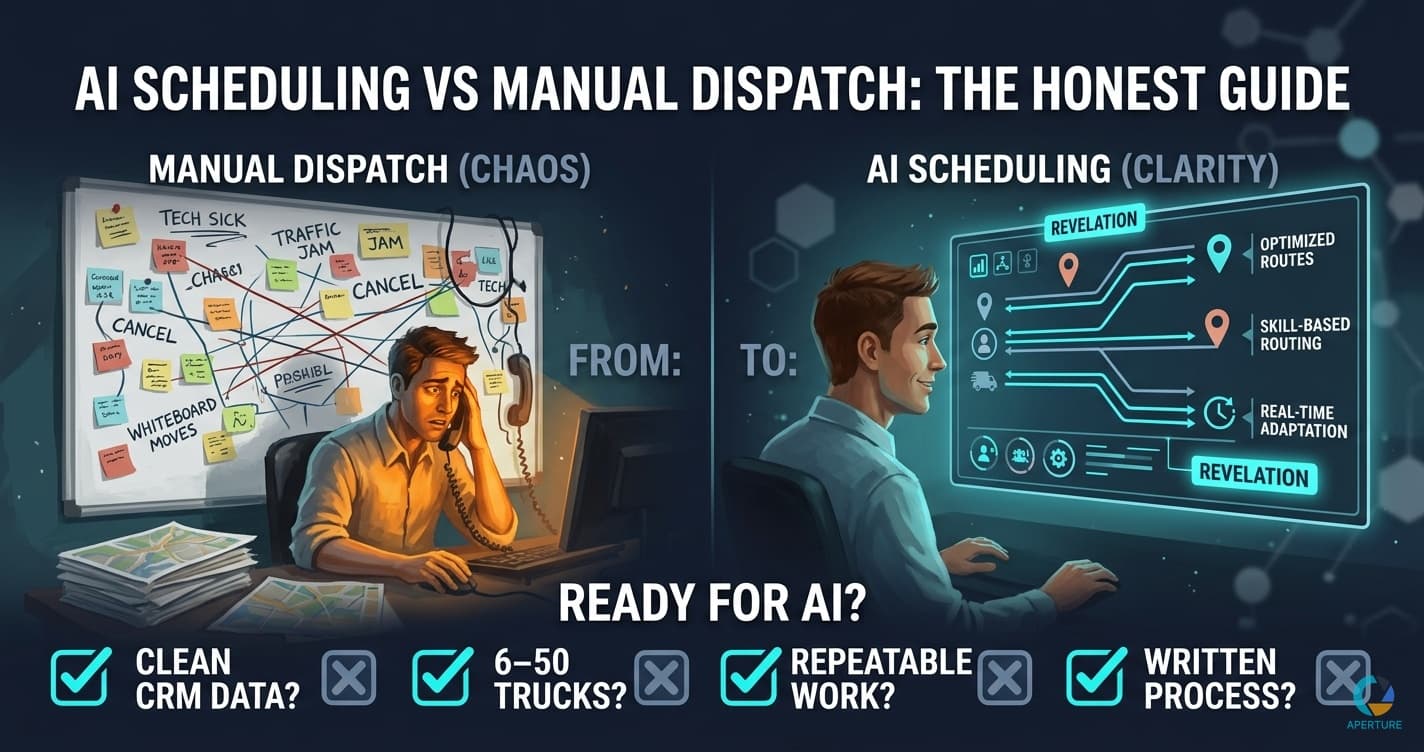
AI scheduling replaces the human dispatcher's judgment calls about which technician goes where with an algorithm that optimizes routes, skills, and customer windows in real time. Manual dispatch keeps the human in the loop and relies on tribal knowledge, whiteboard moves, and phone calls. The real difference between the two is not speed. It is what happens when something breaks: a cancellation, a running-late crew, an emergency call, a tech who calls out sick. Manual dispatch handles the break with a dispatcher scrambling. AI scheduling handles the break by recalculating the day in seconds. Whether that trade is worth it depends on a few specific things about your shop, which this post walks through honestly.
What Is AI Scheduling for a Field Service Business?
AI scheduling is dispatch software that uses an optimization algorithm, and increasingly a language model, to assign jobs to technicians based on multiple variables at once: skill match, drive time, part availability, customer appointment window, and historical job duration. Instead of a dispatcher dragging jobs around a whiteboard, the system proposes the optimal assignment and the dispatcher approves or overrides it.
The important distinction is that AI scheduling is not the same thing as AI call handling, AI quoting, or AI customer support. Those are different layers of the stack. Scheduling is the layer between "job booked" and "technician on site." It is the one that decides who goes where and in what order.
Manual dispatch, by contrast, is what most service shops still run: a dispatcher with a CRM, a phone, and a list of techs, assigning jobs by memory and intuition. At a small shop with five trucks and a dispatcher who has been there for a decade, manual works. At a shop with twenty trucks and turnover in the dispatch seat, manual is where the day falls apart.
What Does Manual Dispatch Actually Cost?
It costs most of the dispatcher's attention, which is a real expense people do not track. It costs the time technicians spend on drive routes that could have been shorter. It costs the revenue on calls nobody answered because the dispatcher was juggling. And it costs the customer experience when the reschedules happen late.
The customer side is measurable. The 2025 Housecall Pro survey of 1,040 US homeowners found that 97% of homeowners say speed and transparent pricing impact their hiring choices, 59% expect text updates during active jobs, 35% are frustrated by late arrivals, and 58% are reassured when they see a technician photo and name before a visit. Every one of those expectations lands on the dispatch function. If the dispatcher is too busy to send the arrival update, the customer experience drops. If the ETA slips without warning, the review drops with it.
The owner side is also measurable. According to a 2024 Slack survey of 2,000 US small business owners, owners lose 96 minutes per day to wasted time, with 29% repeating messages across platforms and 30% searching for information in the wrong places. For a field service shop, a lot of those wasted minutes are the owner stepping in to cover dispatch when the dispatcher gets swamped. Which happens a lot.
Where Does AI Scheduling Actually Beat Manual Dispatch?
Four places, consistently.
1. Recovery From Breakage
The biggest real-world win is what happens when the plan breaks. A tech calls out. A job goes long. Traffic on the 101 adds 45 minutes. The dispatcher's day used to mean manually reshuffling the board and calling three customers to reschedule. AI scheduling reshuffles the board in seconds and sends the arrival update to the affected customers automatically.
This is not a productivity win in the traditional sense. It is a stress win. The dispatcher stops feeling like they are playing Whac-A-Mole for six hours a day. That has a cost nobody puts on the P&L but everybody feels.
2. Route Optimization at Scale
At five trucks, dispatch intuition wins. A good dispatcher knows which tech lives where, who hates traffic on the 10, and who works faster. At fifteen or twenty trucks, the variables outgrow the human. AI scheduling consistently wins at that size because it can optimize for multiple constraints at once without getting tired or distracted. Routes get shorter. Jobs per day go up. Miles per job go down.
The catch: this advantage only shows up if the data is clean. If your CRM has wrong addresses, outdated skill tags, or missing part inventory, the algorithm optimizes against garbage and you get garbage dispatches back.
3. Customer Communication
AI scheduling systems usually come paired with automated customer messaging. The moment the schedule shifts, the affected customers get texts. This is the single biggest customer experience lift for most shops, because the feature that homeowners actually want, knowing where their tech is and when they will arrive, is the one that manual dispatch does worst. It is not that dispatchers do not care. It is that they are triaging, and "text the customer about the 20-minute delay" is the task that gets deprioritized when everything is on fire.
4. Skill-Based Routing
Not every tech can do every job. The new hire cannot install a tankless water heater. The senior tech should not be doing routine tune-ups if there is a complex diagnostic on the board. AI scheduling enforces skill matching as a hard constraint, which manual dispatchers often bend in the moment because they are trying to get the day covered. Bending skill assignments is fine for one job. Doing it 30 times a quarter is how callbacks and warranty complaints pile up.
Where Does AI Scheduling Fail or Underperform Manual Dispatch?
Three places, honestly.
1. When the Input Data Is Wrong
This is the most common failure mode and the one nobody warns you about when they sell you the software. AI scheduling is only as good as the CRM data feeding it. Wrong addresses, outdated skill tags, missing part inventory, stale customer notes, and you get optimized routes that do not match reality. The technician shows up to the right address in the wrong city. The algorithm assigns a furnace install to a tech who does not have the right certification. The customer gets a text saying the crew is arriving at 10am for a job that was canceled yesterday.
This is not a software problem. This is a process problem. If the shop has never captured its dispatch workflow properly, the algorithm is optimizing the wrong thing. This is exactly why process mapping comes before automation, and it is the single biggest reason Gartner predicts that organizations will abandon 60% of AI projects through 2026 for lack of AI-ready data. The quote comes from a February 2025 Gartner press release based on a Q3 2024 survey of 248 data management leaders, 63% of whom either did not have the right data management practices or were not sure if they did. Field service dispatch is a near-perfect example of the same pattern.
2. When the Shop Is Small
Under five trucks, manual dispatch usually wins. The dispatcher knows the techs, the customers, the neighborhoods, and the weird one-off rules that the CRM has never captured. At that size, the algorithm is often slower than the human, because the human has context that took years to accumulate and is impossible to encode without a real capture effort. A shop with three trucks and a dispatcher who has been there eight years does not have a dispatch problem. They have a growth problem. Fix the growth problem first, then revisit dispatch.
3. When the Work Is Not Repeatable
Custom commercial work, new construction, and one-off project-based jobs do not benefit much from AI scheduling. The variables are different every time. The skill requirements are different every time. The duration estimates are unreliable. AI scheduling shines when the work is mostly repeatable, even if the details vary: residential HVAC service, routine plumbing, recurring landscaping, cleaning. It struggles when every job is a snowflake.
What I Learned Watching Service Businesses Buy Software They Could Not Use
After I sold my agency in 2021, I spent a few years doing fractional operations consulting. Agencies, production companies, training businesses, service outfits. Different industries, same story on repeat. The owner would tell me they had a software problem. Then we would actually look at the work, and it was a process problem dressed up as a software problem.
One pattern I saw over and over: a business would spend thousands on a new platform, roll it out, and six months later the team would still be running the business out of the same spreadsheets, sticky notes, and Slack messages they were using before. The software was not broken. It was configured with whatever default settings came out of the box, because nobody had sat down and written out what the business actually needed the software to do. The spec was missing. The tool could not guess.
I watched one owner show me a field service platform he had paid to implement, open to a beautiful dispatch board, and then pull up the real dispatch board on his phone: a text thread with his two senior techs. That was the actual system. The software was decorative. And when I asked him to walk me through how he decided who got which job, he paused, thought about it, and said "it depends." Three words that meant six unwritten rules and about 45 minutes of real conversation to extract.
The fix was never buying different software. The fix was writing down the "it depends" logic, feeding it into the platform he already owned, and then getting out of the way. AI scheduling has the same failure mode, just faster and more expensive. If the capture work has not happened, the algorithm cannot do the job, because the job has never been defined.
Which Type of Field Service Business Should Try AI Scheduling First?
The best candidates share a few traits. They run six to fifty trucks. The work is mostly repeatable, residential, or maintenance-heavy. They have a CRM that is actually kept up to date, or an owner willing to clean it up before going live. They have a dispatcher who is either overwhelmed or a bottleneck for growth. And they are already losing real money to no-shows, late arrivals, or unanswered calls.
Shops that should wait: businesses under five trucks, shops with dirty CRM data, shops with highly custom work, and owners who have not documented their dispatch workflow yet. The AI will not fix what the process has not defined.
According to a 2022 Gartner survey of 699 executives, 80% believe automation can be applied to any business decision. The belief is widespread. The execution is not, because the prerequisite work, documenting the dispatch workflow, is the part nobody wants to do.
What About the Missed-Call Problem Nobody Talks About?
Here is the thing most field service owners already know and most vendors do not want to discuss: before you worry about AI scheduling, you probably have a front-door problem. Calls coming into the shop during business hours get missed because the dispatcher is overloaded. Calls coming in after hours go to a voicemail that nobody checks until the next morning. Either way, the money leaves.
This is where AI starts to matter in a way that is different from scheduling. An AI receptionist that answers calls, qualifies the job, books the appointment, and routes urgency to a human dispatcher is not the same product as AI scheduling. It is the layer in front of scheduling. And for most shops in the six-to-twenty-truck range, it recovers more revenue per dollar than any scheduling optimization because it stops the leak at the source.
The Housecall Pro survey cited earlier found that 53% of homeowners are comfortable with AI handling initial inquiries. That comfort is new, and it is specific to the front door, not to complex diagnostics. Homeowners do not want AI telling them why their furnace is broken. They want a human to show up on time. But they are fine with AI picking up the phone, confirming the appointment, and making sure the human actually gets dispatched.
The right order for most field service shops is: fix the front door first, then fix dispatch, then worry about AI. If calls are being missed, AI scheduling will optimize a day that is built on fewer jobs than the shop could be running. The three phases of AI implementation apply here too: map what is happening, automate the repeatable parts, and only then add intelligence on top.
How Would You Actually Think About This Decision?
The test is simple. Before you buy anything, write down what your current dispatch day looks like. The trigger that starts the day, the sequence of decisions, the rules the dispatcher follows, and the exceptions that break the plan. If you can write that down in an afternoon, you are ready to evaluate AI scheduling tools seriously. If you cannot, the AI is not your next step. Capturing the process is your next step.
Ready to get the dispatch workflow out of your head? Start a conversation with Steve at Aperture OS →
Evan Van Dyke is the founder of Aperture OS. He spent seven years running a marketing agency, scaling 100+ businesses, eventually systemizing it to three hours a week, and sold it in 2021. He now builds AI automation systems for business owners. About Evan →
Frequently Asked Questions
Q: What is the difference between AI scheduling and manual dispatch for field service businesses? Manual dispatch uses a human dispatcher assigning jobs from a whiteboard or CRM based on memory, intuition, and phone calls. AI scheduling uses an optimization algorithm to assign jobs based on skill match, drive time, part availability, and customer windows, then recalculates when anything changes. The biggest real-world difference is how quickly the system recovers from a cancellation, no-show, or running-late crew.
Q: When should a field service business switch from manual dispatch to AI scheduling? Usually around six to fifteen trucks, when the variables outgrow what a single dispatcher can hold in their head without dropping customer communication. Under five trucks, a good dispatcher with deep context often outperforms an algorithm. Over twenty trucks, manual dispatch is almost always the bottleneck for growth, assuming the CRM data is clean enough for the AI to optimize against.
Q: Why do AI scheduling tools fail in some field service shops? The most common failure is dirty CRM data. Wrong addresses, outdated skill tags, missing part inventory, and stale customer notes produce optimized routes that do not match reality. The AI is only as good as the data feeding it. The second most common failure is trying to automate dispatch before the shop has documented its dispatch workflow. Algorithms cannot infer a process that was never written down.
Q: Does AI scheduling replace the dispatcher? Not in most shops. It changes what the dispatcher does. Instead of manually assigning every job, the dispatcher approves or overrides AI recommendations, handles exceptions, and focuses on customer communication and escalations. The role often becomes more strategic and less reactive, which is usually the point for shops that are losing good dispatchers to burnout.
Q: What should a field service owner fix before investing in AI scheduling? The front door. If calls to the shop are being missed during business hours or after hours, AI scheduling will optimize a day that is running at fewer jobs than it could be. Fix call handling first, clean up the CRM data second, and document the dispatch workflow third. Only then is AI scheduling the right next investment. See how Aperture OS maps the order →