
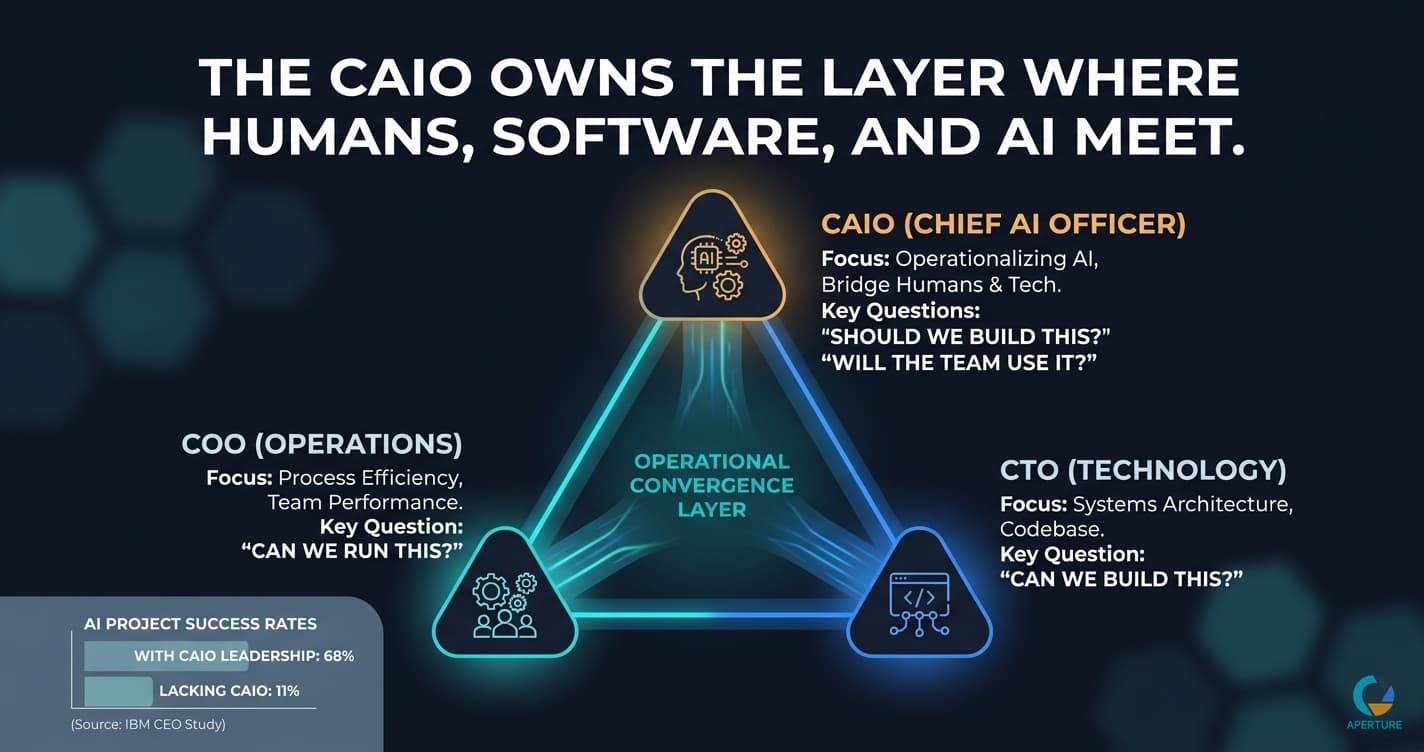
A Chief AI Officer is the executive responsible for how a company adopts, implements, and governs artificial intelligence across the organization. The role connects business priorities with the technology and the people doing the work. If AI experiments keep landing on your desk without becoming useful systems, the missing piece may be clear ownership of those decisions.
In IBM's 2026 CEO survey, 76% of participating organizations reported having a CAIO, compared with 26% in 2025. The study surveyed 2,000 CEOs and equivalent senior leaders across 33 geographies and 21 industries between February and April 2026. That describes the surveyed organizations, not every business. It doesn't establish that your company needs a separate executive role.
What Does a Chief AI Officer Actually Do?
A Chief AI Officer connects business objectives to decisions about AI: which problems to address, what to build, how employees will use it, and how to check the results. The responsibility also includes deciding where AI is unsuitable and setting expectations for data use, human review, and ongoing ownership.
I break the work into five functions. This is my working model for AI leadership, rather than an industry-standard job description:
Observe. Understand how the business actually operates. Where is time being spent? Where is knowledge trapped in someone's head? What breaks when a key person is out?
Diagnose. Identify the root cause. For a hypothetical example, onboarding might take 14 days because three handoffs happen over email and nobody owns the sequence. Before choosing a tool, find out why the handoffs stall.
Architect. Design the system that fixes it. Map the process. Decide what ordinary software can automate, where AI could help, and what stays human. Specify how the team will catch mistakes and handle exceptions.
Orchestrate. Coordinate implementation across teams. Agree who builds, who tests, who approves, and who trains the people doing the work. Make sure the team has time to adopt the change.
Consolidate. Measure and refine. Check whether the system saves time without increasing errors, rework, or customer frustration. Give someone responsibility for maintaining it after the initial project ends.
Is a Chief AI Officer the Same as a CTO or COO?
A CAIO focuses on AI decisions across the company, often working with leaders who already own technology and operations. Those responsibilities can overlap. A CTO or COO can lead AI work if they have the skills, authority, and capacity; a separate title is one way to assign responsibility, not a requirement.
The useful questions stay the same regardless of title. Can we build this? Can the team run it? Should we build it, given the cost, the risks, and the alternatives?
If an existing leader can answer those questions and coordinate the work, you may only need specialist help. If AI decisions repeatedly stall between teams, examine who has authority to resolve them. Adding another executive without clarifying that responsibility could add more friction.
Is a Chief AI Officer the Same as an AI Consultant?
A CAIO usually carries ongoing responsibility for AI decisions and results. A consultant's responsibilities depend on the engagement: advice, a defined implementation, training, or longer-term support. Some people provide fractional executive leadership through a consulting arrangement. The contract and day-to-day responsibilities tell you more than the label.
Ask who stays accountable after the recommendations arrive. Who helps the team put the system to work? Who deals with the problems they find? What does your team own when the engagement ends?
If you want the leadership function on a part-time basis, the fractional Chief AI Officer guide covers what to look for and how to evaluate the scope.
Why Do AI Projects Struggle to Deliver Results?
AI projects can struggle when the problem is unclear, the data is inadequate, or the technology doesn't fit the task. RAND's interviews with 65 experienced AI practitioners identified these issues, along with inadequate infrastructure and a focus on technology over the problem being solved. That research doesn't establish a universal failure rate for everyday AI adoption.
The study focused on AI and machine-learning development projects and excluded projects that merely used pretrained large language models. It should not be treated as a forecast for every business trying a chatbot or an AI-assisted workflow.
Before buying another tool, I'd want answers to five questions:
- What specific work needs to improve, and how does it run today?
- Is the necessary information available and suitable for the task?
- Would a simpler process or ordinary automation solve the problem?
- How will the team check the output and handle mistakes?
- Who owns adoption, maintenance, and the decision to stop if it doesn't work?
A CAIO can help coordinate those decisions. Hiring one doesn't guarantee success, and a capable existing team can make them without that title. The difference between AI and traditional automation matters when choosing what to build.
How Much Does a Chief AI Officer Cost?
The cost depends on the responsibility you're hiring for, the experience required, and the employment or engagement model. A full-time compensation package can include salary, benefits, and equity. A fractional engagement prices a defined scope and level of availability. Compare the complete commitment, including implementation and your team's time.
A part-time arrangement can fit recurring decisions that don't require a full-time leader. A full-time role can fit work that needs continuous coordination, deep internal knowledge, or sustained oversight. Neither model proves how efficiently someone works with AI.
For my own fractional AI leadership work, scope and pricing are customized. The starting point is understanding what needs to change and who will do the work. There isn't a revenue or headcount threshold that answers that for you.
Do You Actually Need a Chief AI Officer?
You need clear ownership of AI decisions that affect your business. Whether that requires a CAIO depends on the work, its risks, and the capacity of your existing leaders. Start by identifying what keeps stalling, then choose between internal ownership, coaching, a focused implementation, or ongoing leadership support.
You may be able to start with narrower help if:
- You have one process to improve and someone who can own it.
- The main gap is teaching employees to work with AI and check the results.
- Your existing technical and operational leaders can coordinate implementation.
Ongoing AI leadership may help if:
- Several teams are making conflicting decisions about tools, data, or priorities.
- Experiments keep starting, but nobody owns implementation or measures the outcome.
- Your leaders need help deciding what to build, what to defer, and how to manage the risks.
Undocumented processes don't automatically disqualify you from getting help. Understanding and mapping the work may be the first task. It also gives you something concrete to discuss before committing to a larger engagement.
What I Learned Building Systems and AI Fluency
I spent seven years building and running a marketing agency. I scaled it to seven figures, grew the team to 30 people, and eventually systematized myself out of the day-to-day. My personal involvement dropped from 60+ hours a week to under three. The company was acquired in 2021.
The framework I built was BEST: Build your SOPs, Eliminate, Software automate, Transfer. I documented the processes, removed unnecessary steps, automated the repeatable work, and handed the remaining responsibilities to the right people. AI now gives us more options within that work. Software automation and transfer remain separate decisions; someone still needs to own the result.
In more recent coaching with CrewTracks, Casey Black said during session three, "It isn't as scary anymore." Later that day, he emailed about cleaning roughly 1,900 junk CRM records in about 15 minutes. He had observed the first two sessions and was now applying what he'd learned to his own work.
That combination matters to me: someone feeling more comfortable with AI and then putting it to work on a real task. Teaching the team to carry the work forward is part of the job.
What Should You Do Next?
Start with the work that keeps landing back on your plate. One recurring task may call for a process map and a focused build. A team struggling with practical AI skills may need coaching. Decisions spanning several teams may justify ongoing leadership. You can start small enough to see whether the help is useful.
If you want to understand one process first, get started for free with Steve. He helps map the work and develop an implementation plan, with guidance for building it or the option to hire Aperture to implement it.
If you want to discuss coaching or fractional AI leadership with me, book a 30-minute discovery call →. Bring the work that keeps depending on you. My engagements happen remotely, with scope and pricing shaped around the work we agree to take on.
Evan Van Dyke is the founder of Aperture OS. He spent seven years running a marketing agency, serving 100+ businesses, eventually systemizing it to three hours a week, and sold it in 2021. He now builds AI automation systems for business owners. About Evan →
Frequently Asked Questions
Q: What is the difference between a Chief AI Officer, a CTO, and a COO? A CAIO focuses on AI decisions across the organization, working with the people who own technology and operations. A CTO or COO can also lead that work when they have the skills, authority, and capacity. Clear responsibility matters more than creating a separate title.
Q: How much does it cost to hire a Chief AI Officer? Costs vary with experience, scope, availability, and whether the role is full-time or fractional. Compare the complete commitment, including implementation, software, and your team's time. My fractional AI leadership engagements have customized scope and pricing, discussed through a discovery call.
Q: Why do AI projects struggle to deliver results? Problems can include unclear objectives, inadequate data, unsuitable technology, and weak coordination. RAND's interviews with experienced AI practitioners identified several of these issues in AI and machine-learning development projects. That does not mean every project fails for the same reason or that hiring a CAIO guarantees success.
Q: Do small businesses need a Chief AI Officer? Some need ongoing AI leadership, while others can start with coaching, a focused implementation, or an existing leader taking responsibility. Assess the operational burden and the decisions that need an owner. Revenue and employee count alone don't determine the right choice.
Q: What does a Chief AI Officer do on a daily basis? The work varies by company, but can include setting priorities, reviewing proposed systems, coordinating implementation, and checking results and risks. My working model covers five functions: observe, diagnose, architect, orchestrate, and consolidate. If your first step is understanding a recurring task, map it with Steve.